
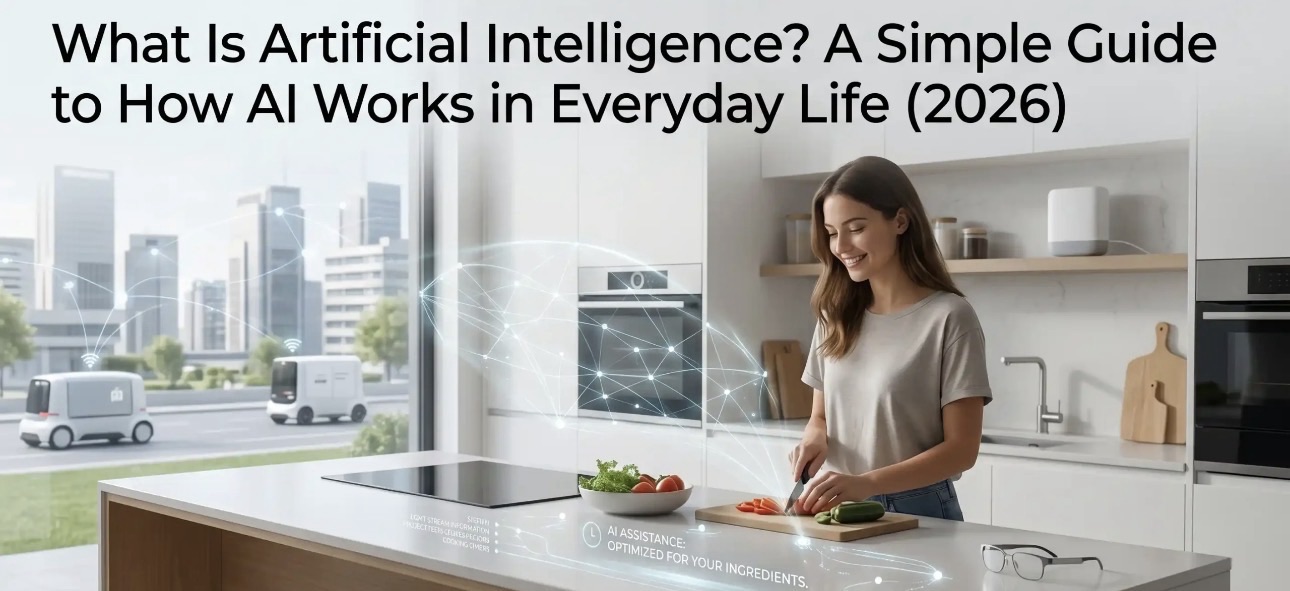
Artificial Intelligence (AI) has become one of the most important technologies of the modern era. While many people still associate AI with science fiction, robots, or futuristic concepts, the reality is much simpler: artificial intelligence is already part of daily life, and millions of people use it every single day without even realizing it.
From smartphones and search engines to online shopping, banking apps, navigation systems, and productivity tools, AI is quietly transforming the way we work, communicate, learn, and make decisions.
In this complete beginner-friendly guide, you’ll learn what artificial intelligence is, how it works, where it’s used in 2026, its benefits, risks, and why AI is expected to become even more important in the coming years.
What Is Artificial Intelligence?
Artificial intelligence refers to computer systems that can perform tasks that normally require human intelligence.
These tasks include:
- Learning from data
- Recognizing patterns
- Understanding language
- Solving problems
- Making predictions
- Automating repetitive tasks
- Generating content and recommendations
In simple terms, AI allows machines and software to analyze information and make decisions based on that information.
Unlike traditional software that follows fixed instructions, AI systems can improve over time by learning from new data and experiences.
Why Is Artificial Intelligence Important in 2026?
Artificial intelligence is becoming increasingly important because it helps individuals and businesses:
- Save time
- Increase productivity
- Reduce repetitive work
- Improve decision-making
- Personalize digital experiences
- Analyze large amounts of information quickly
As technology continues to evolve, AI is now integrated into many of the services people use daily, making digital tools smarter and more efficient.
Many experts consider AI one of the biggest technological shifts since the invention of the internet.
How Does Artificial Intelligence Work?
At its core, AI works by processing large amounts of data and identifying patterns.
The basic process looks like this:
Step 1: Data Collection
AI systems receive information from various sources, including:
- User behavior
- Images
- Text
- Audio
- Sensors
- Online interactions
The more relevant data available, the more accurate the system can become.
Step 2: Pattern Recognition
The AI analyzes data to identify relationships and patterns.
For example:
A streaming platform may learn which movies you watch most often.
An online store may learn which products you’re likely to purchase.
Step 3: Machine Learning
Machine learning allows AI systems to improve their performance over time.
Instead of being manually programmed for every situation, the system continuously learns from new information and user interactions.
Step 4: Prediction and Action
After learning patterns, AI can:
- Recommend products
- Suggest content
- Detect unusual activity
- Answer questions
- Automate tasks
This entire process often happens in seconds.
Real-Life Examples of Artificial Intelligence
Many people use AI dozens of times every day without realizing it.
1. Search Engines
Modern search engines use artificial intelligence to understand search intent and deliver more relevant results.
AI helps determine:
- Which pages to show
- Which answers are most useful
- How results should be ranked
2. Streaming Platforms
Services like Netflix, YouTube, and Spotify use AI recommendation systems.
These systems analyze:
- Viewing history
- Listening habits
- Preferences
- User behavior
The result is personalized recommendations designed specifically for each user.
3. Online Shopping
E-commerce platforms rely heavily on artificial intelligence.
AI helps with:
- Product recommendations
- Dynamic pricing
- Customer support
- Fraud detection
- Inventory management
This creates a more personalized shopping experience.
4. Virtual Assistants
Voice assistants use AI to understand and respond to human language.
Common tasks include:
- Setting reminders
- Answering questions
- Managing schedules
- Controlling smart devices
These systems continue improving as natural language processing technology advances.
5. Navigation and Maps
GPS applications use artificial intelligence to:
- Predict traffic
- Suggest faster routes
- Calculate travel times
- Detect road incidents
Without AI, modern navigation would be far less efficient.
Artificial Intelligence in the Workplace
One of the fastest-growing uses of AI is workplace productivity.
Businesses now use AI to:
Automate Repetitive Tasks
Examples include:
- Data entry
- Email sorting
- Appointment scheduling
- Report generation
This allows employees to focus on higher-value activities.
Analyze Large Data Sets
AI can process enormous amounts of information much faster than humans.
This helps organizations:
- Identify trends
- Detect anomalies
- Improve forecasting
- Make informed decisions
Improve Customer Support
Many companies now use AI-powered chatbots and virtual assistants.
Benefits include:
- Faster response times
- 24/7 availability
- Reduced operational costs
- Improved customer satisfaction
Artificial Intelligence and Content Creation
One of the most visible developments in 2026 is AI-generated content.
AI tools can now assist with:
- Writing articles
- Creating summaries
- Generating ideas
- Producing marketing materials
- Editing text
- Translating content
Rather than replacing human creativity, these tools often act as productivity assistants that help users work faster and more efficiently.
Benefits of Artificial Intelligence
Artificial intelligence offers numerous advantages for individuals and organizations.
Increased Productivity
AI can automate routine tasks, allowing people to focus on more important work.
Time Savings
Many tasks that previously took hours can now be completed in minutes.
Better Personalization
AI delivers recommendations and experiences tailored to individual users.
Improved Decision-Making
Advanced analytics help businesses and individuals make more informed choices.
Greater Accessibility
AI-powered tools can assist people with disabilities through voice recognition, text-to-speech systems, and other accessibility features.
Risks and Challenges of Artificial Intelligence
Despite its benefits, AI also presents challenges that should not be ignored.
Privacy Concerns
Many AI systems rely on large amounts of personal data.
Users should understand:
- What data is collected
- How it is used
- Who has access to it
Misinformation
AI-generated content can sometimes contain inaccuracies.
It is important to verify information from reliable sources before making important decisions.
Job Transformation
While AI creates new opportunities, some roles may change significantly due to automation.
This makes digital skills and continuous learning increasingly important.
Ethical Considerations
Questions around transparency, accountability, and fairness continue to be major topics in AI development.
Responsible AI usage remains a priority for governments, businesses, and technology providers.
Artificial Intelligence Trends for 2026 and Beyond
Several major trends are expected to shape the future of AI.
More Personalized Experiences
Digital platforms will become increasingly tailored to individual preferences and behaviors.
AI-Powered Productivity Tools
Businesses and professionals will continue adopting AI assistants to streamline workflows.
Smarter Devices
Phones, wearables, vehicles, and home devices will become more intelligent and responsive.
Improved Healthcare Applications
AI is expected to play a growing role in diagnostics, treatment planning, and medical research.
Stronger Security Systems
Artificial intelligence will help identify cyber threats faster and improve digital security.
Frequently Asked Questions
Is artificial intelligence dangerous?
AI itself is not inherently dangerous. However, like any technology, it must be used responsibly and with appropriate safeguards.
Do I use AI every day?
Yes. Most people interact with AI daily through search engines, social media, navigation apps, streaming platforms, online shopping, and digital assistants.
Can AI replace humans?
AI can automate certain tasks, but human creativity, judgment, emotional intelligence, and critical thinking remain essential in many areas.
Do I need technical knowledge to use AI?
No. Most modern AI-powered tools are designed for everyday users and require little or no technical expertise.
Final Thoughts
Artificial intelligence is no longer a futuristic concept—it’s a practical technology that powers many of the digital services people rely on every day. From personalized recommendations and virtual assistants to workplace automation and smarter online experiences, AI is transforming how we interact with technology in 2026.
Understanding what artificial intelligence is and how it works can help you make better use of modern digital tools, stay informed about technological developments, and prepare for a future where AI becomes even more deeply integrated into everyday life.
As AI continues to evolve, those who understand its capabilities, benefits, and limitations will be best positioned to take advantage of the opportunities it creates.
Autor: Equipo tritableta.
Deja una respuesta