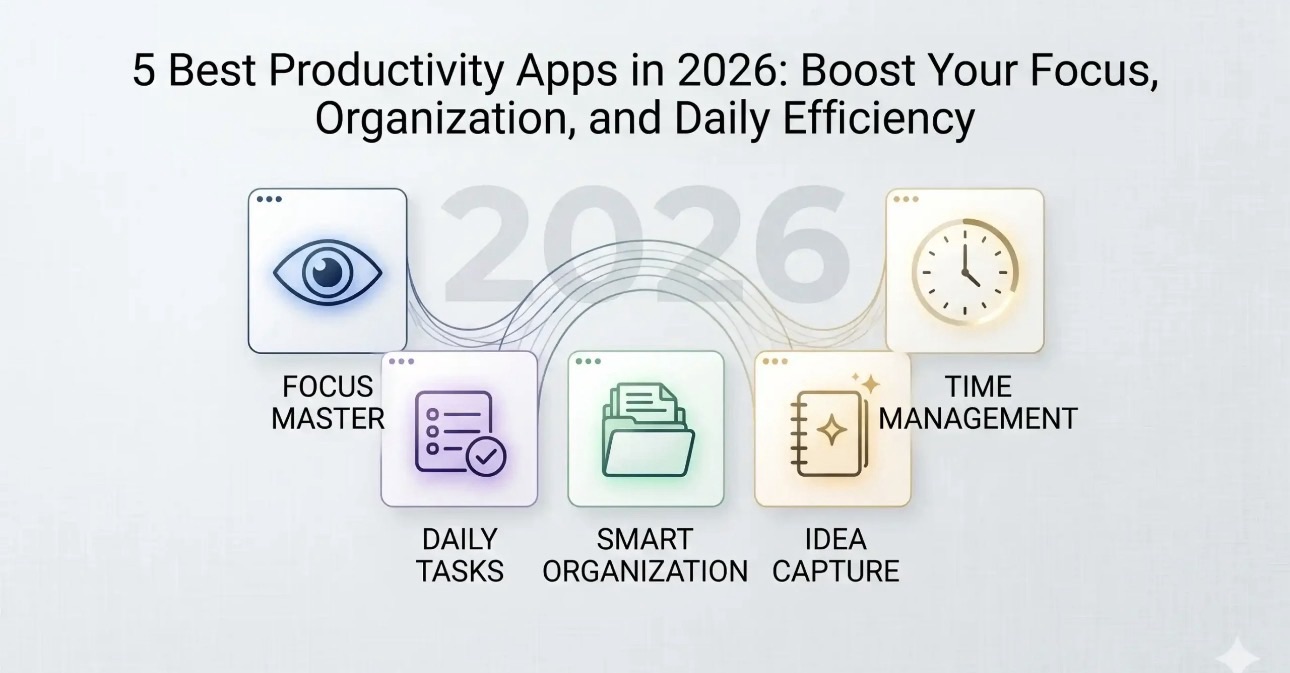
In today’s fast-paced digital world, productivity has become one of the most valuable skills. Whether you’re a student, entrepreneur, freelancer, remote worker, or business professional, the right productivity tools can help you save time, reduce stress, and achieve more every day.
The good news is that modern technology offers powerful applications designed to improve organization, task management, focus, and collaboration. However, with thousands of options available, choosing the right tools can be overwhelming.
In this guide, we’ll explore five of the best productivity apps in 2026 and explain how they can help you work smarter, stay organized, and manage your time more effectively.
Why Productivity Apps Matter in 2026
Digital distractions are everywhere.
The average person checks their phone dozens of times per day, receives hundreds of notifications each week, and constantly switches between tasks.
This creates:
- Reduced focus
- Lower efficiency
- Increased stress
- Poor time management
- Missed deadlines
Productivity applications help solve these problems by providing structure, organization, and automation.
Benefits of Productivity Software
| Benefit | Impact |
|---|---|
| Better Organization | Less mental clutter |
| Improved Focus | Higher quality work |
| Time Management | More efficient schedules |
| Goal Tracking | Increased motivation |
| Team Collaboration | Faster project completion |
The right tools can significantly improve both personal and professional performance.
1. Notion: The Ultimate All-in-One Workspace
Notion remains one of the most versatile productivity platforms available.
It combines multiple tools into a single workspace, allowing users to manage notes, projects, databases, calendars, documents, and knowledge systems.
Key Features
- Task management
- Project planning
- Digital note-taking
- Content calendars
- Team collaboration
- Knowledge management
Why People Love Notion
Its flexibility makes it suitable for virtually any workflow.
Students use it for study organization, entrepreneurs manage businesses with it, and teams coordinate complex projects from a single dashboard.
Best For
- Entrepreneurs
- Students
- Content creators
- Project managers
- Remote teams
2. Todoist: Simple Yet Powerful Task Management
If you prefer simplicity over complexity, Todoist remains one of the best task management applications available.
Its clean design helps users focus on what matters most without unnecessary distractions.
Key Features
- Daily task lists
- Priority levels
- Due dates
- Recurring tasks
- Productivity tracking
- Cross-device synchronization
Why Todoist Stands Out
Many productivity tools become complicated over time.
Todoist maintains a balance between functionality and simplicity, making it ideal for users who want an efficient task management system without a steep learning curve.
Best For
- Busy professionals
- Freelancers
- Students
- Personal productivity
3. Google Calendar: Master Your Schedule
Time management is one of the foundations of productivity.
Google Calendar remains one of the most effective tools for organizing schedules, meetings, deadlines, and personal commitments.
Key Features
- Event scheduling
- Reminders
- Recurring appointments
- Multiple calendars
- Team scheduling
- Device synchronization
Productivity Tip
Many successful professionals use time blocking, a strategy where specific hours are reserved for focused work, meetings, exercise, or personal activities.
Google Calendar makes this process incredibly simple.
Best For
- Professionals
- Business owners
- Remote workers
- Students
4. Forest: Stay Focused and Beat Distractions
One of the biggest productivity challenges today is maintaining concentration.
Forest takes a unique approach by turning focus sessions into a game.
When you start a work session, a virtual tree begins growing. If you leave the app to browse social media or get distracted, the tree dies.
Benefits
- Reduced phone usage
- Improved focus
- Better work habits
- Increased awareness of distractions
Why It Works
Forest uses behavioral psychology and gamification to encourage deeper concentration and healthier digital habits.
For many users, this simple concept dramatically improves productivity.
Best For
- Students
- Remote workers
- People struggling with distractions
5. Trello: Visual Project Management Made Easy
Trello remains one of the most popular project management tools worldwide.
Its visual board system makes it easy to organize tasks and track progress.
Core Features
- Kanban boards
- Task cards
- Due dates
- Team collaboration
- Checklists
- Workflow tracking
Advantages
Trello provides an instant visual overview of projects, helping teams and individuals understand exactly what needs to be done.
Its simplicity makes it ideal for both personal and professional use.
Best For
- Small businesses
- Teams
- Freelancers
- Project managers
Bonus Productivity Tools Worth Considering
Several additional applications are becoming increasingly popular in 2026.
Emerging Productivity Apps
| App | Primary Use |
|---|---|
| ClickUp | Advanced project management |
| Obsidian | Personal knowledge management |
| Grammarly | Writing productivity |
| Slack | Team communication |
| Microsoft Copilot | AI-powered assistance |
| ChatGPT | Research and content creation |
| Asana | Workflow management |
Many professionals combine several of these tools to create a complete productivity system.
How to Choose the Right Productivity App
The best application depends on your needs.
Choose Notion If:
- You want an all-in-one workspace
- You manage multiple projects
- You enjoy customization
Choose Todoist If:
- You want simple task management
- You prefer a clean interface
- You need daily organization
Choose Google Calendar If:
- Scheduling is your biggest challenge
- You manage many appointments
- You use multiple devices
Choose Forest If:
- You struggle with distractions
- You spend too much time on your phone
- You want better focus habits
Choose Trello If:
- You work on projects
- You collaborate with others
- You prefer visual organization
Common Productivity Mistakes to Avoid
Even with great tools, productivity can suffer from poor habits.
Common Mistakes
❌ Using too many apps at once
❌ Constantly checking notifications
❌ Not planning the day in advance
❌ Multitasking excessively
❌ Ignoring breaks
The goal is not to use more tools, but to use the right tools consistently.
Frequently Asked Questions
What is the best productivity app in 2026?
There is no universal answer. Notion, Todoist, Google Calendar, Forest, and Trello are among the most popular and effective options.
Can productivity apps really save time?
Yes. Properly used productivity software can significantly reduce wasted time and improve organization.
Should I use multiple productivity apps?
Many users combine two or three complementary tools rather than relying on a single application.
Are free versions sufficient?
For most individuals, free plans provide enough functionality. Premium features become more useful for teams and advanced users.
Which app is best for remote work?
Notion, Trello, Slack, and Google Calendar are particularly useful for remote teams and digital collaboration.
Final Thoughts
Productivity is not about working harder—it’s about working smarter.
The right productivity applications can help you organize your tasks, manage your time effectively, reduce distractions, and achieve your goals more efficiently.
Whether you choose Notion for organization, Todoist for task management, Google Calendar for scheduling, Forest for focus, or Trello for project management, building a consistent productivity system can have a major impact on your personal and professional success.
In 2026, mastering digital productivity tools is no longer optional—it is one of the most valuable skills for thriving in an increasingly connected world.
Autor: Equipo tritableta.
Deja una respuesta